I was having a quiet ale the other day when three young women at the bar were conducting an animated, and quite vocal, conversation.
Their high standards were in evidence in their quick and decisive evaluations of men on a dating site one had called up on her cellphone, but that palled and the conversation turned to excursions at friends' weddings.
There was a good bit of detail about getting hammered on the party bus and about staying awake for an entire night after multiple rounds of Red Bull and vodka. It was at that point that the bartender, who, like me, had been a silent listener, remarked that his bar didn't offer Red Bull. One of the young women commented, "At the bars in center city Philly, to keep the kids from Jersey out, they won't stock Red Bull."
I offer this bit of learning to friends and colleagues who also enjoy an occasional quiet pint: Your chances of avoiding the company of obnoxious drinkers will improve if you first ascertain that the bar does not stock Red Bull.
Monday, January 16, 2017


Friday, December 30, 2016
Dark imaginings on the right
Curious attitudes keep surfacing on the right.
Last week Carl Paladino got himself into hot water by making
remarks to an online publication. He said that he hopes President Obama
“catches mad cow disease after being caught having relations with a Herford
[sic]” and that he would like for Michelle Obama to “return to being a male and
let loose in the outback of Zimbabwe where she lives comfortably in a cave with
Maxie, the gorilla.”
Amid the ensuing uproar he released a craven statement
apologizing to “the minority community,” saying that he meant to circulate the
remarks among friends instead of for publication, and insisting “I certainly am
not a racist.”
Two things are immediately apparent: (1) Mr. Paladino does
not understand how bovine spongiform encephalopathy is transmitted, and (2) he
is in fact a racist. His apology merely illustrates how deeply political
correctness has penetrated society; even people who make blatantly racist
remarks do not want to be called racists.
The sorts of things Mr. Paladino said keep cropping up in
recesses of the internet and have for the past eight years of the Obama
administration. “Obama is gay, Michelle is trans,” &c., &c. But Carl
Paladino is not some sweaty troll in a basement surrounded by canned goods and
a private arsenal as he awaits the black insurrection. Six years ago Carl
Paladino was the Republican nominee for governor of New York.
I don’t see people on the left speculating on what Donald
Trump does between the sheets—perhaps the mind revolts at the image. I see
people on the left attacking Donald Trump for remarks that appear to support
racist, sexist, and xenophobic attitudes. Those are attacks on political grounds, and they mirror the
attacks from the right on President Obama’s political
actions.
But in the darker regions of the right this peculiar
fascination with race and sexual behavior is a kind of chronic delirium. I’m an
English major and a journalist, not a psychologist, but it is hard to avoid the
conclusion that remarks like Mr. Paladino’s are both politically and personally
morbid.
-->
Friday, December 9, 2016
The late Mr. Saunders
We said goodbye to Saunders this morning.
A trip to the veterinarian on Wednesday yielded this
information: He was suffering from a fever, he was seriously anemic, he had
feline leukemia, and the prognosis was not good.
Kathleen and I made the painful decision that we did not
want to prolong his suffering. So we brought him home and spent the day
yesterday giving him treats, stroking him, speaking to him with affection,
indulging his wishes, and saying farewell. This morning we took him to the
Aardmore Veterinary Hospital, where he was gently put beyond the reach of pain.
You may recall from earlier posts that he showed up two
years ago, an abandoned, hungry stray who immediately sized us up as easy
marks. We fed him, we took him in, we got him treated by the vet, and we made
him part of the household.
He remained determinedly indoor-outdoor, patrolling the
neighborhood as if he were its mayor, paying visits to other households and depositing
the occasional mouse (and sometimes a young rat) on our front sidewalk. He went
out in the rain and the cold, and he gamboled
in his first snowfall.
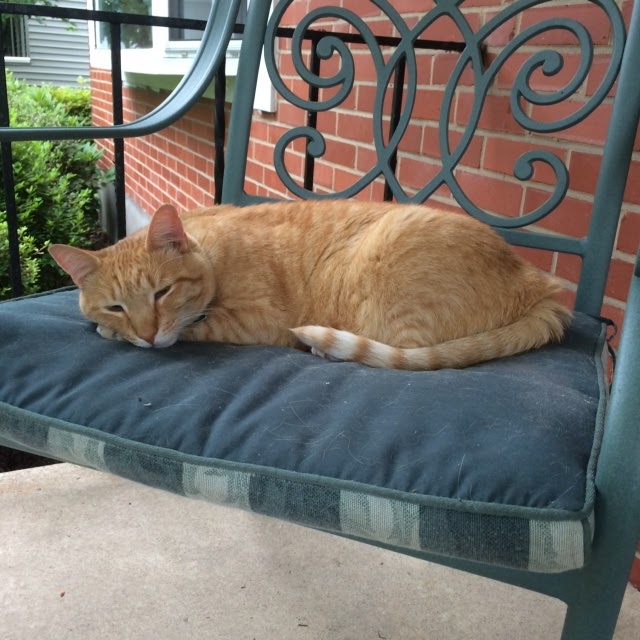
He was a handsome orange cat, quickly growing into those big
paws we noticed on his arrival. And he was ever an affectionate cat, the
sweetest-tempered cat, who purred loudly every time I picked him up. His
presence in the bay window comforted and calmed us, and, like a dog, he came to
greet me when I arrived home at night after work.
-->
But now he is gone, and I will think of him always as serenely
dozing on his chair on the porch, savoring the sunlight and the fragrant
breeze, the sweet, sweet stray who for two all-too-short years with us had
food, shelter, love.
Tuesday, October 25, 2016
Time goes by
It was on October 23-25, 1997, that the American Copy Editors Society conducted its first national conference, at the University of North Carolina at Chapel Hill. I was there.
These photos, which recently surfaced in a folder deep in a file cabinet, were from the workshop I conducted there at the invitation of Pam Robinson.

"Getting Back to the Word," on issues of English usage, used material I had developed for staff workshops at The Baltimore Sun and from our in-house newsletter on writing and editing, Publish and Be Damned.


Over the nineteen years since, as I have come to examine the things about English usage that I had been taught, looking at evidence in Bryan Garner's four edition of his usage manual, at the evidence presented by lexicographers and linguists about usage, and at the evidence of my own eyes, the advice in that workshop has undergone revision.
These photos, which recently surfaced in a folder deep in a file cabinet, were from the workshop I conducted there at the invitation of Pam Robinson.


My participation in ACES had been encouraged by The Sun's publisher, Mike Waller, himself a former copy editor, and by John Carroll, the editor. When demand came for me to present this workshop, and others on writing and editing, their encouragement continued. I have presented "Getting Back to the Word" at other national ACES conferences and at publications around the United States.

Over the nineteen years since, as I have come to examine the things about English usage that I had been taught, looking at evidence in Bryan Garner's four edition of his usage manual, at the evidence presented by lexicographers and linguists about usage, and at the evidence of my own eyes, the advice in that workshop has undergone revision.
Saturday, October 1, 2016
My bully is dead
Though I allowed my subscription to the Flemingsburg Gazette, the paper I worked for in high school and college, to lapse, I still occasionally check the Independent-Ledger in Maysville. Given that I have been away for more than forty years, I mainly scan the obituaries.
A few weeks ago, there he was, the bane of my life in the third and fourth grades, my principal bully. I was a skinny bookworm and teacher's pet. He was bigger, more muscular, a halting student at best, and he was seldom at his best. He enjoyed tormenting me.
Now he is dead, an old guy, like me, apparently mourned by his daughters.
I don't visualize him as an adult with children. He is fixed in my head as he was then. The subsequent fifty-five years don't signify. (I will not describe him further, because he has children who mourn him.)
There is the problem. He is fixed in my head.
He, and the subordinate bullies who sometimes chimed in, established in my mind that I am someone to be bullied, someone who lacks power, someone with no recourse. My parents and teachers knew that I felt bullied, but they were at a loss to do anything beyond allowing the children to work it out on their own.
My bully, to my astonishment, metamorphosed into adult for whom someone could bear affection. I, in turn, metamorphosed into an adult with a family, a profession, a reputation, a standing.
But I am also someone who typically shies away from conflict and confrontation, because I was thoroughly programmed early on to see myself as unable to prevail in such circumstances.
Sixty-five years old, and I could still use some work.
Friday, September 30, 2016
As you make your plans for this weekend ...
please recall that The Old Editor plans to be at Ryan's Daughter in Belvedere Square around five o'clock Sunday afternoon for a pint or two of Smithwick's and conversation with any readers of the blog (or viewers of the videos) who care to show up.
Surely you don't think that it's wholesome for him to drink alone.
Surely you don't think that it's wholesome for him to drink alone.
Sunday, September 25, 2016
The Old Editor's thirst
It appears that I will be dangerously at loose ends a week from today, Sunday, October 2. If any of my readers fancy a pint with The Old Editor, I plan to be at Ryan's Daughter, 600 East Belvedere Avenue in Belvedere Square, around five o'clock. I will be the gray-haired gentleman nursing a glass of Smithwick's at the bar. You will be a reader looking for a quiet interval to chat at leisure.
Saturday, August 13, 2016
Make sure your bright-eyed scholar is properly outfitted
With the imminent start of the school year, you have been supplying your young charges with all the kit they will need: a full spectrum of gel pens, notebooks full of inviting blank pages, dozens of apps for laptops, tablets, and iPads.
And if your bright-eyed scholar aspires to be a writer, you may also have thrown in a copy of Strunk and White.
Well, mistakes are made. But they can be corrected.
At Amazon.com you can find, for an exceedingly modest price, The Old Editor Says, a pithy compilation of invaluable advice about writing and editing. Grammar Girl loved it, and your embryo Scott Fitzgerald or Max Perkins will benefit enormously.
Operators are standing by.
Sunday, August 7, 2016
Advice for an election year
From The Vanity of Dogmatizing (1661) by the Rev. Joseph Glanvill:
"They that have never peep't beyond the common belief in which their easier understandings were at first indoctrinated, are indubitabely assur'd of the Truth, and comparative excellence of their receptions, while the larger Souls, that have travail'd the divers Climates of Opinions, are more cautious in their resolves, and more sparing to determine."
"They that have never peep't beyond the common belief in which their easier understandings were at first indoctrinated, are indubitabely assur'd of the Truth, and comparative excellence of their receptions, while the larger Souls, that have travail'd the divers Climates of Opinions, are more cautious in their resolves, and more sparing to determine."
Thursday, July 14, 2016
Here comes the sun
This morning, after weeks of inquiry, estimates, inspections, construction, further inspections, paperwork, and appointments, Kathleen and I threw the switches to turn on the solar panels that Solar City has installed on our roof.
This afternoon, as the sun heats up Baltimore to a muggy ninety-five degrees, it will also be running the fan on our air conditioner.
This afternoon, as the sun heats up Baltimore to a muggy ninety-five degrees, it will also be running the fan on our air conditioner.
Subscribe to:
Posts (Atom)